Featured

At War with Words: Myths and Narratives at Military Writing Centers

By Aileen Brenner Houston

What challenges do military students face with academic writing, and how can we work through them at the writing center?

Exploring the narratives and myths surrounding writing conventions at the Naval Postgraduate School with Graduate Writing Center Coach Abby McConnell.

In terms of writing, there’s a myth that you either know how to do it or you don’t. That you have the skill set and it’s not one you can grow…. The gray area is really difficult for all these students, and the process of writing is so mysterious.

— Abby McConnell, Graduate Writing Center Coach, Naval Postgraduate School

In my five and a half years as a writing coach and thesis processor at the Naval Postgraduate School, I’ve come across a wide array of student writers, who bring with them a wide array of personal narratives. I’ve met with the resolute infantryman who sits down confidently at my workstation and admits with smiling bravado, “I can’t write. Do your best with me.” I’ve met published poets who can manipulate the English language in a million beautiful ways, but who stumble over scientific studies. I’ve met with expectant mothers stretching their Dress Whites, and Turkish officers whose families are back home amid a political crisis, and fire chiefs who are called away from papers to tend to a blaze.

Image from the New York Times

Abby McConnell has been my colleague as a full-time writing coach at NPS’s Graduate Writing Center for six months, and the military culture is new to her. But her vast professional work with college students has prepared her well to navigate NPS’s crowd of military and government folks from around the world. All college students, she says, regardless of their age, station, or walk of life, face the same challenges with time management. NPS students are no exception as they juggle their military and government lives with their new school duties—and with their families, who they have often uprooted for this journey of higher education.

Abby’s specialty is helping students chunk out time and, importantly, motivation to work on their writing amid the structured chaos.

It’s common that a new student at NPS has not written an academic paper in ten to fifteen years, Abby reminds me. I think back to my first days as a writing coach, and I, too, remember the students’ visceral uneasiness. It’s easy for me to forget that these students’ graduate programs are brief, and they haven’t had the dedicated years that I’ve had to get comfortable with the cold ivory tower of academia. It’s intimidating for them, Abby says, because the skill sets and the culture of the academy are so far removed from their typical lives. Military and government culture—battlefield culture, even—makes sense for these students, but academic culture is uncomfortably foreign terrain.

“A lot of them come here and they’re immediately overwhelmed because they’re told it’s gonna be easy,” Abby explains. “And, I mean…easy compared to being shot at, maybe, but it’s just an entirely different culture and world, and they’re not sure what to cling to when they get here.”

The students have entered what language expert Mary Louise Pratt calls a contact zone: a place where cultures clash, particularly when it comes to linguistic and writing norms. For NPS students, professional writing until this point has meant memos and emails. Terse reports. Copied-and-pasted directives and instructions. Now, however, it means policy analysis. Experiment write-ups and literature reviews. Personal reflections. And, for almost all students, it means a thesis or dissertation, which is published publicly on the internet and shared with academics and their command teams alike.
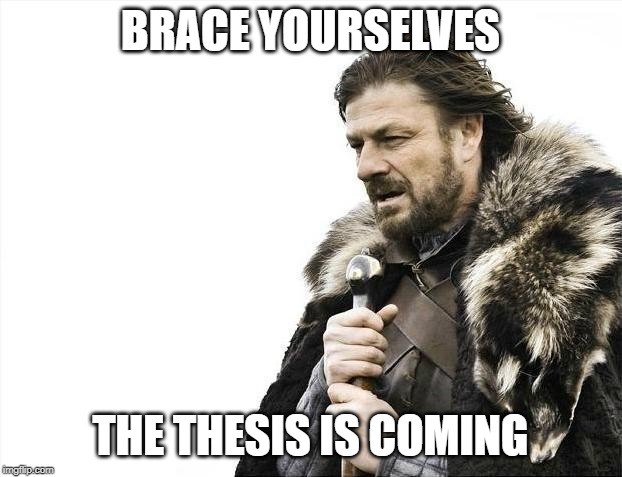
Created with Imgflip

Because NPS is a graduate school, all the students have a bachelor’s degree under their belts. But, as Abby mentions, that degree was typically achieved many years ago, before their military or government service began. Sometimes it required little to no writing, and sometimes the degree was from a hands-off program that provided scant feedback. And writing centers at undergraduate military institutions may be dealing, too, with a wider student body of basic writers.

Students at NPS, like their undergraduate counterparts at other military institutions, struggle to understand academic voice, and how it can be used to describe their national security work. Particularly when those worlds seem so far removed. Abby finds that students struggle, especially, with understanding what analysis is, how to structure an argument, how to craft a thesis statement, and how to incorporate source material with their own ideas.

“I tell them it’s like learning another half of a language … or at least another system they have to master,” says Abby.

One block to learning that system, however, is the myths about academic writing the students bring with them.

When Writing is Nonrational: Countering Myths and Crafting New Narratives

When faced with the nonrational, Craig R. Smith says that we create myths to help us make sense of our surroundings. And for many college students, writing is certainly the stuff of the nonrational.

“You … run into the myth that there’s a formula you can give them: how to write a paper, how to create an argument,” Abby says. “The gray area is really difficult for all these students, and the process of writing is so mysterious.”

“In terms of writing,” she continues, “there’s a myth that you either know how to do it or you don’t. That you have the skill set and it’s not one you can grow.”

According to Smith, myths are based on forces beyond human control (21). So when students’ attitudes toward writing ascribe to this binary, it takes the pressure off: I’m just a bad writer, they believe; no point in fighting it.

At the writing center, however, we remember another of Smith’s guiding principles of myths: while their forces may be beyond human control, humans can control their interpretation.

Countering students’ myths about writing, Abby says, involves “getting them to put something on paper and giving them permission to write a shitty first draft.” She reminds them that what shows up on the page will never completely match what was in their head, but that writing and rewriting will get them closer. “I’m very honest,” she says. “It’s going to suck, and you have to spend a lot of time.”
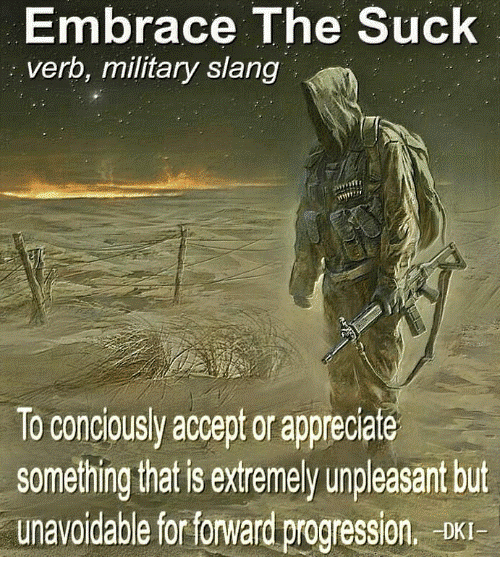
Image from ES Memes

So, at the writing center, we work to create new narratives with the students—ones that build confidence and shed the myths that hinder learning and performance.

“We function to hopefully help them become better thinkers and better writers, and in doing so they gain confidence in that area,” Abby says. “But I believe we can [also] be a neutral sounding board, a place without judgement where they can come … to have conversations and get help. All these guys are separated from their platoon or their unit, and they’re upended and dropped here. I think it’s important for them to be able to ask for help, even though that’s not a military norm.”

While Abby finds that students have typically shed the this-will-be-easy myth after a few weeks, the asking-for-help-is-a-sign-of-weakness myth takes longer to overcome. Getting students comfortable with the norms and conventions of this new world, particularly the writing conventions, in large part means helping them understand their new multifaceted audiences—and navigating their audiences’ biases, as well as their own.

An Academic Audience

Abby finds that students’ biggest challenge is “unlearning the military way of writing,” which relies on heavy use of acronyms and short sentences, and provides little context. The U.S. Army, for instance, advises that effective writing “is understood by the reader in a single rapid reading and … will be concise, organized, and to the point” (Preparing and Managing Correspondence 6). Similarities aside, discussed in my next post, this is a far cry from the style of a well-developed academic argument.

Early student drafts, Abby says, are often condensed and missing “connectors.” And according to famed management consultant Peter Drucker, this is a cardinal sin of effective communication. If the audience has no context—if the writing is not within “the recipient’s range of perception” (262)—communication is doomed from the get-go.

As a writing coach, Abby understands this innately. “They’re [used to] writing to an audience that already has a common understanding. We have to break them out of that and help them write to readers who have no context for what they’re writing about.”

This goes for both sides of our students’ audience: the military side and the academic side. In their writing, our students must mediate these two cultures to align, as Drucker puts it, their perceptions, expectations, and demands.

To attune to these audiences, our students must be sensitive to their diverse viewpoints. And it’s not just that the viewpoints themselves are diverse or polarizing; it’s that, within the community, those diverse and polarizing viewpoints affect each other and create a different, more global, dynamic. Doreen Starke-Meyerring, a professor of education, calls this a phenomenon of “globalized identities” (474).

Writing as Cultural Mediation

Pratt, in her ruminations on linguistic cultural clashes, believes that our job as teachers and instructors is “to figure out how to make that crossroads the best site for learning that it can be” (40). Storytelling, she says, and therefore its connection to our students’ globalized identities, is part of that. Abby agrees.

“All the research on wars [at NPS] is important,” Abby tells me, “but the [assignments that students] get more out of are the few personal reflective essays they have to write. It’s always some of the most interesting stuff I’ve read about their own journey and their own history with writing.”

Navigating this contact zone between military and academia through personal writing, if we take Pratt’s advice, helps students and their readers “engage with suppressed aspects of history (including their own histories)” (40).

“A had a great [paper] from a student from Georgia, the country of Georgia, that is,” Abby recalls, “who wrote about how his language is like poetry and doesn’t really have a linear way about it. He used to write poetry … from the warfront. It helps them reflect and take a moment to see where they are and where they’ve been, which is important for everybody.”

Linguist Deborah Cameron, too, believes that when writing lessons embrace a “culture of self-improvement” and lean on honest, nonjudgmental disclosure, communication improves (74–75). This engagement with intimate ideas in an academic setting strengthens students’ written voices but also familiarizes them with “ground rules for communication across lines of difference and hierarchy” (Pratt 40)—an important lesson for students who will need to write for global communities that include their professors, peers, academics, policymakers, and national and international partners.

And, according to Pratt, the benefits of these “rhetorics of authenticity” go beyond the student writer. They provide what she calls “cultural mediation” (40).

NPS is home to military and government professionals from the United States but also from nations across the globe—from Saudi Arabia, to Mali, to Greece and Argentina and Indonesia and Germany. Faculty and students from a diverse range of cultures meet at NPS to learn, and write, together.
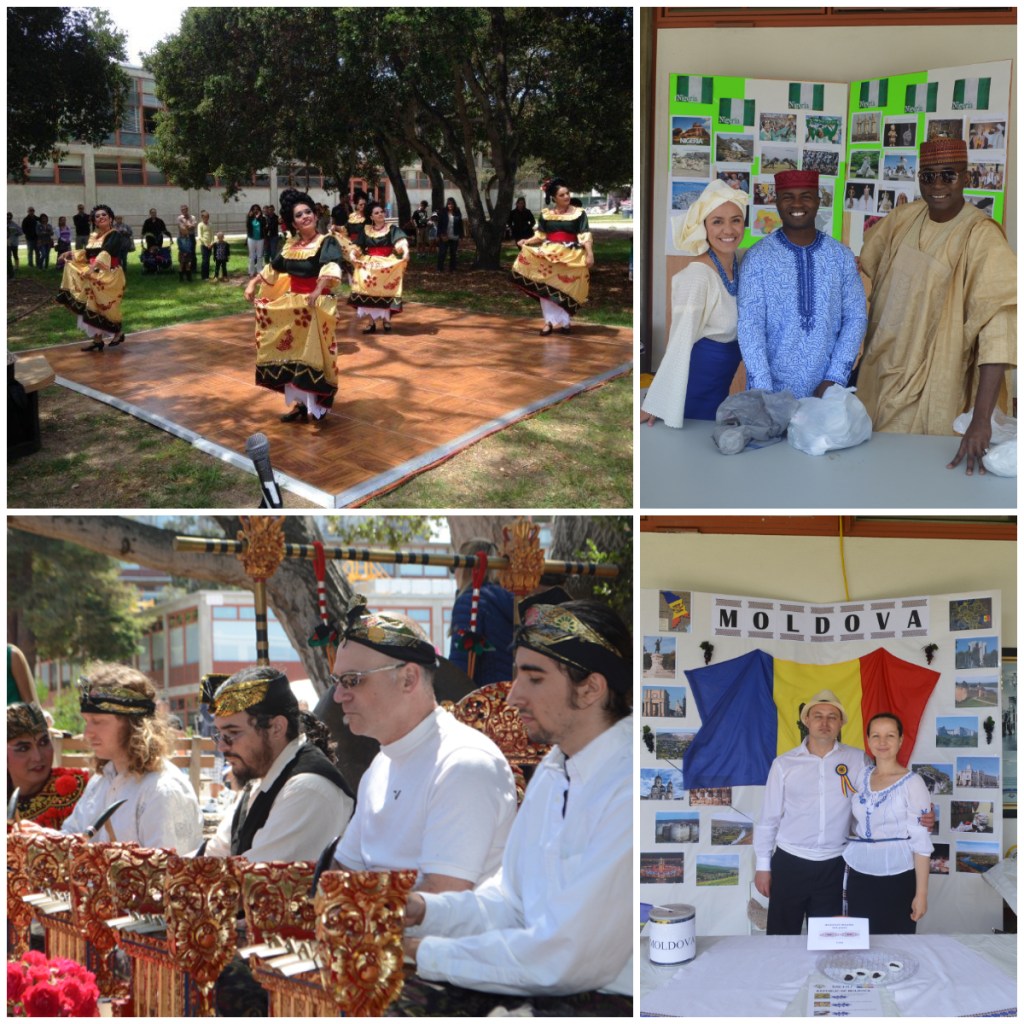
On the quarterly International Day, NPS students share cultural traditions such as food and performance with the community. Photos from the Naval Postgraduate School International Graduate Programs Office.

At the writing center, Abby says she’s “hyperaware of the cultural differences,” particularly when it comes to writing conventions. “I try to figure out where the student’s coming from culturally, or writing-wise or storytelling-wise. I’ve had a couple students tell me that putting something bottom-line-upfront like we do in academic papers is culturally not how you’d write something in, say, Uganda. I try to think about that as I coach them. Again, they are learning this strange little language of this specific way of writing.”

Starke-Meyerring also explains how the prevalence of digital networks and internet-based genres, too, has expanded the audiences and cultures that access, and participate in, our writing. This is no different in academic writing, particularly for NPS students, whose thesis and dissertation research is published online. We must therefore, as Starke-Meyerring puts it, “understand how to connect and communicate”—how to engage our various stakeholders—“across diverse cultural contexts” (476).

Abby says she’s “at a loss for words sometimes because, how do you talk about this to somebody who’s grown up in Uganda? Sometimes you don’t. You just listen…. I try to get them to tell me that story—why it matters or what their experience has been—and be supportive [so] that they feel like their work here is purposeful, and hopefully effecting change and making some kind of contribution in their home country.”

Beyond the Writing Center

For military and government students, however, writing goes far beyond the academic world or the context of the country.

“Our communication today isn’t face to face,” Abby says. “It’s email, or in the military it’s memos or executive summaries. So [our students] have to be able to write clearly and succinctly with some kind of flow and structure so that their higher-ups can understand and they can keep things working and moving.”

The tenets of academic writing—for instance, clarity, conciseness, logical organization, and sound arguments—are the same tenets of effective communication in any organization. And the lessons we impart at the writing center remind students to think critically about their message and their audience, with an eye for problem-solving. Abby believes that students’ work to improve their writing at NPS will make them better communicators in general, which in turn will make them more valuable to their command teams, and therefore more promotable. Not to mention the benefits at home.

“Once you can clearly write a paper,” Abby says, “you’re going to be more articulate…maybe you can even communicate better with your wife.”
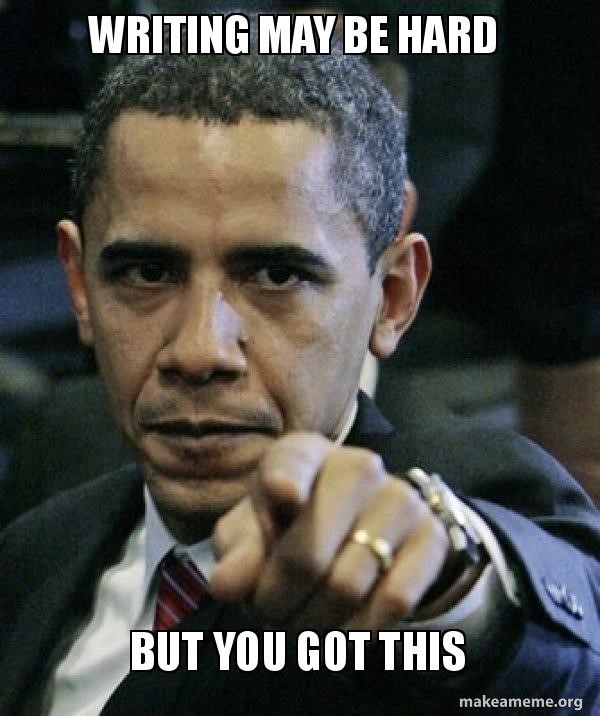
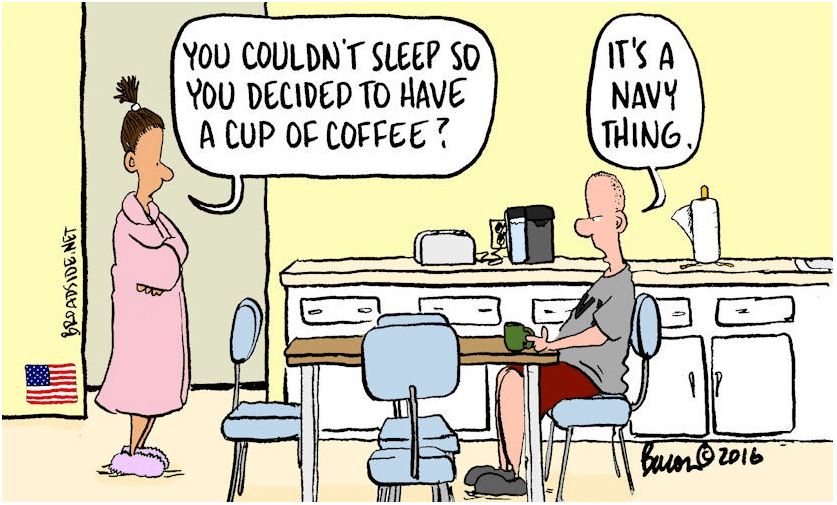
Image from Better Memes

Works Cited

Cameron, Deborah. “Golabalization and the Teaching of ‘Communication Skills.’” Globalization and Language Teaching, edited by David Block and Deobrah Cameron, Routledge, 2002, pp. 67–82.

Drucker, Peter F. The Essential Drucker: The Best of Sixty Years of Peter Drucker’s Essential Writings on Management. Harper, 2008.

Pratt, Mary Louise. “Arts of the Contact Zone.” Profession, 1991, pp. 33–40.

Preparing and Managing Correspondence. Army Regulation 25-50. Department of the Army, 2013.

Smith, Craig R. Rhetoric and Human Consciousness: A History. 4th ed., Waveland P, 2013.

Starke-Meyerring, Doreen. “Meeting the Challenges of Globalization: A Framework for Global Literacies in Professional Communication Programs.” Journal of Business and Technical Communication, vol. 19, no. 4, Oct. 2005, pp. 468–99.


The views expressed on this website are the author’s alone. They do not reflect the views of the Naval Postgraduate School.
“Talk in All its Forms”: Social Media and the Writing Center

By Aileen Brenner Houston

How can writing centers harness public communications concepts to engage with students and faculty?

Exploring social media use for military writing centers.

[T]he best breaker of old rhythms, the best creator of new ones, is our style of live intervention, our talk in all its forms.

Stephen North

If writing centers are going to offer advice on communicating effectively, they ought to be able to prove they know how to do it out in the wild, right?

Nancy Vazquez

SCENE: Monday. 0900. Finals week. The writing center. Your first appointment of the day. You snagged the work station by the window. Plants are watered. Birds are chirping. Pens are organized by color and bleed risk. Your tea is warm, and your copy of The Bedford Guide for Writing Tutors is peeking from the bookshelf. You’re having an unusually good morning.

ENTER: Frantic senior. Has never used the writing center. Hasn’t had coffee yet. This is apparent.

YOU: Finals week, am I right?
SENIOR: [Stares at you blankly. Sets phone on table. Facebook app dings.]
YOU: Amiright, haha?? [Big smile]
SENIOR: [Plots your death]

Silence. Birds stop chirping. Plants wilt noticeably.

YOU: I read through your paper, thanks for sending it in advance. You have a strong thesis statement. Your client form didn’t say what you’d like to work on, but we could discuss methods for more clearly linking your evidence to the thesis statement, to help its strength ride through the literature review and conclu—
SENIOR: My professor said I can’t turn this in until I fix the grammar mistakes. He told me to go to the writing center.

Your tea mug falls over spontaneously, violently.

YOU: Oh, OK. I did mark a few patterns I noticed, like some issues with parallel construction in the literature review, so we could certainly kill two birds. Have you heard the term parallelism before when talking about grammar?
SENIOR: Really I just need the paper to be corrected. Like, proofread.

Somewhere in New York, Stephen North tweets about a sudden migraine.

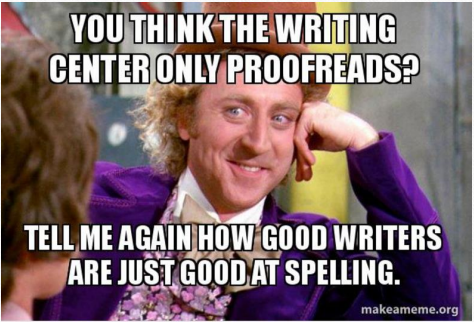
YOU: Well, we don’t really proofread at the writing center, but we can definitely look at some patterns and revision techniques.
STUDENT: That’s what my professor sent me here for, though. He said to have it proofread. Can’t you just fix it?

Cold oolong bleeds onto your lap. Your Bedford Guide jumps from the shelf, stabs itself in heart.

END SCENE

Social Misconceptions

In his infamous “The Idea of a Writing Center,” published in 1984, English professor and writing center director Stephen North is exasperated. On college campuses, he laments, writing centers are misunderstood, seen as a place for remedial instruction and quick grammar fix-its. He delves into the misplaced stigmas about writing centers and his frustrations with the academy attitudes that perpetuate them.

“In short,” North says, “we are not here to serve, supplement, back up, complement, reinforce…. We are here to talk about writers.” This includes, he says, talking to faculty about the work of writing centers in our quest to dispel myths and craft more accomplished student communicators (440–41).

To do that, however—to talk to writers, to talk to faculty—we also need them to talk to us. With us. This means relying on talk, to borrow from North, “in all its forms” (443). Which in turn means seeking, and fostering, authentic conversations with students and faculty.

Campus engagement is a necessity for all writing centers, including those at military colleges—and especially for writing centers like ours at the Naval Postgraduate School, where there is no course-mandated requirement for students to take advantage of our resources.

As our students slide into younger generations for whom public, web-dependent communications are the comfortable norm (see Twenge), and as military and civilian programs alike increase their focus on online and distance-learning platforms (Education for Seapower; Vazquez), social media offer an avenue for engagement worth exploring.

Social Media in the Military and the Writing Center

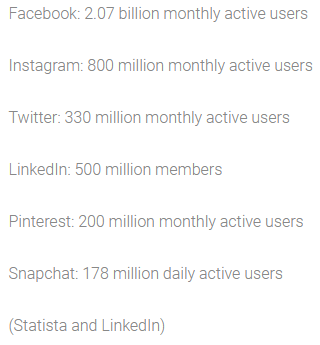
By 2021, estimates project that 3.1 billion people worldwide will be using social media; this is an impressive 17% increase from 2018, and a 12% increase from 2019 (Clement; Dopson). The are a wide breadth of platforms, some of the most popular of which are shown below.

Statistics from 2018. Image from Ibrisevic.

Our students are among these social media users (see Boykin and Rice). And so are their commanders, their generals, their secretaries of defense, and their joint chiefs of staff, who use social media to communicate both personally and professionally (Walinski 10).

The U.S. military, as an organization, also understands the importance of harnessing social media toward engagement. In his Air University master’s thesis, Major Ryan Walinski notes, “As technology continues to develop, and online communication becomes more prevalent worldwide, the U.S. military believes that the foundation of their future relevant communication interaction will occur by leveraging New Media technologies and infusing the technology into their military culture” (1).

Walinski explains that social media has been used in the military (for over a decade now) to disseminate information, educate the public, gather “dynamic feedback,” improve the military’s image, boost troop morale, and dispel rumors (14–17).

Social media is a growing necessity in the nonprofit world, as well, where various platforms are used to share news, foster brand recognition, and fundraise—all with an eye for audience convenience (Dopson).

For writing centers, social media offer platforms to combat the myths and stigmas over which North laments. Nancy Grimm, once director of the writing center at Michigan Technological University, believes this type of attention and engagement is in our nature as writing center professionals. “Because writing centers have been in vulnerable positions for many years,” she writes, “they are accustomed to frequently checking to see how they are regarded by others and adjusting their behavior and adapting their services to improve this regard” (534). Because social media can be leveraged to proactively engage faculty, students, and administration, the platforms may allow us to spark and foster dialogue, and address conflict (see Ullmann 4–6).

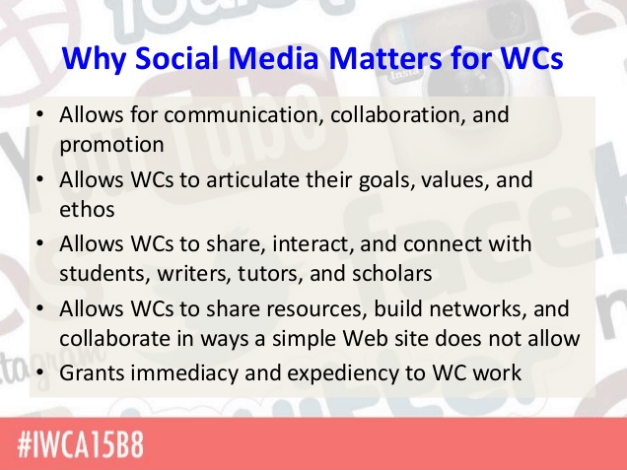
Presented at the International Writing Center Association’s 2015 conference (Erwin et al.)

Advocates for social media use at writing centers tout the platforms’ ability to promote campus awareness about the center, facilitate networking opportunities with other writing centers, and provide cheap, effective marketing (“Boosting Your Writing Center’s Social Media Presence”). Though it can be a time-consuming undertaking admits Jennifer Fandel, administrator of the University of Wisconsin–Madison Writing Center, “Communicating online, where people can take action by clicking a link or forwarding a message, is crucial for the opportunity it gives an organization to see that people are listening.”

Everything’s Bigger in (the) Texas (A&M Writing Center)

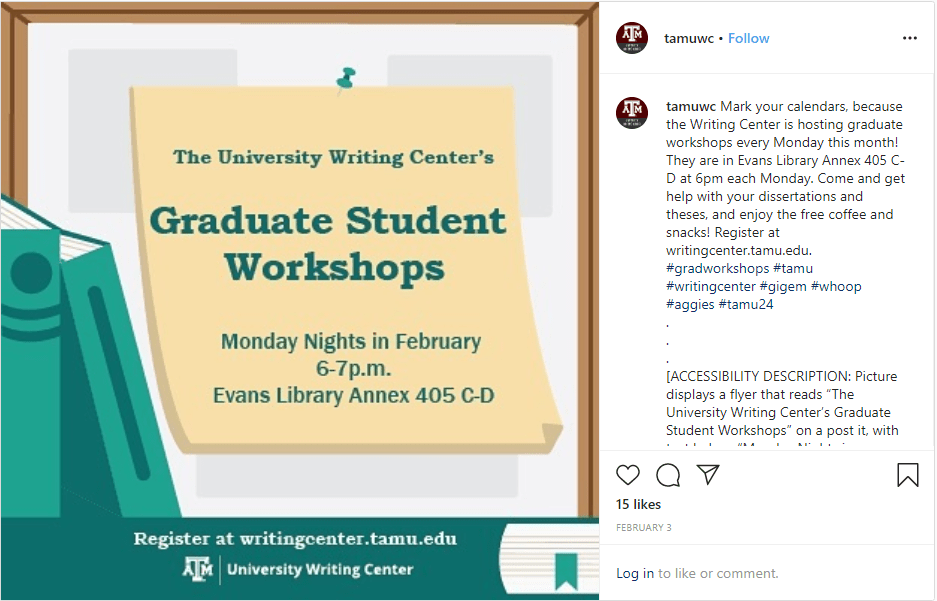
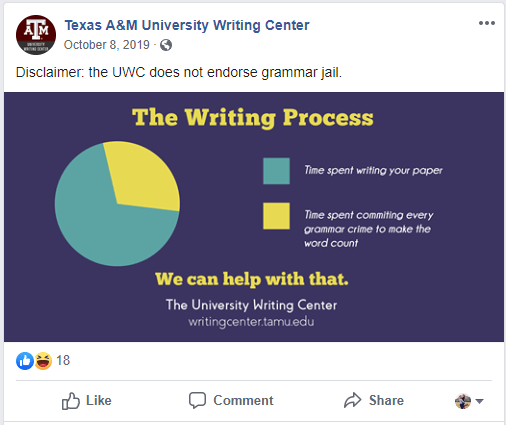
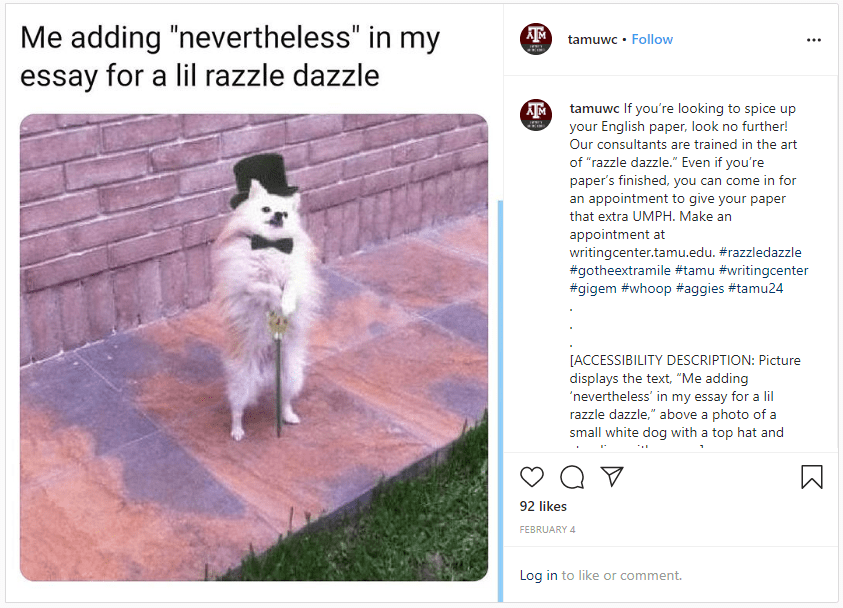
While some military writing centers have dabbled in social media use, the most prolific current examples come from civilian institutions. Texas A&M’s University Writing Center offers a robust example. For instance, the center advertises events and services on its Facebook page, where it also shares articles and memes.

From the Texas A&M University Writing Center Facebook Page

But Texas A&M doesn’t stop there: the writing center maintains active and responsive accounts, too, on Twitter, Instagram, Pinterest, and YouTube. Some of its YouTube videos have over 100,000 views.

As a testament to its social media engagement, I reached out to the Texas A&M University Writing Center through Facebook Messenger, and the center’s director, Nancy Vazquez, responded in a staggering thirteen minutes.

The writing center’s social media strategy, Vazquez explains, is about balancing content. “While we’re certainly using platforms to push our message,” she says, “we also offer content that’s just meant to be engaging and enjoyable. Nobody goes on social media to read a press release. We try to balance announcements about our services and events with general social media shenanigans.”

This approach is in action on the center’s Instagram account, where Vazquez says the writing center tends to catch current students. Most of the center’s Instagram content is posted by student representatives, under the administrators’ guidance.

But the center’s social media use goes beyond student engagement. Vazquez says the sites allow them to model “good communication practices” that show students how to adjust their content and tone for different rhetorical situations. The social media sites have also boosted the writing center’s “profile” within the university community, which Vazquez believes is “just as important as reaching individual students.”

Stars and Stripes and Social Media

Although social media platforms provide military leaders, organizations, and individuals a tool for open communication … they bring with them a variety of new concerns, risks, and challenges.

Walinski (20)

As Walinski notes in his thesis, public communication and social media strategies are particularly complicated for government organizations. We must carefully avoid posting PII or FOUO content, and must be vigilant of OPSEC (22). Walinski concludes, however, that the Department of Defense “must not resist the use of this technology altogether but learn to incorporate its use, while maintaining security protocols, into their daily environments” (24).

Our service academies typically already have robust social media policies to guide us. At NPS, for instance, common-sense guidance such as “stay on topic” and “consider your audience” serves a larger purpose of preventing inadvertent OPSEC violations (“Social Media Guidelines”). Policies also require web content to comply with Section 6 (“Polices and Requirements”), and link to relevant directives and instructions (see, for instance, Secretary of the Navy 7-21–7-22).

Luckily, as most military writing centers maintain pages or blogs on their college or university’s larger website, administrators are likely familiar with web guidelines; if they are not, the Public Affairs Office is a good place to start.

The service branch may also have social media guidance, such as the Navy Command Leadership Social Media Handbook, which explains how command teams should set objectives, select platforms, and abide by records-keeping policy. While designed for command teams, such guidance can help military writing centers understand their audience and communicate within genre expectations in the discourse community.

Forward March: Social Media Considerations for Writing Centers

[The Army] wanted to open up lines of communication that reached across all generations and demographics, with the goal of initiating conversation and dialogue-centric interchanges.

Walinski (14, citing Perry)

Before establishing social media sites, marketing writer Elise Dopson reminds organizations to plan ahead by:

  • Deciding what they want to achieve with their social media presence
  • Setting goals
  • Understanding their target audience
  • Determining which platforms are most useful
  • Developing a strategy
  • Considering time management

Walinski describes cultural considerations, too, that may affect social media use among and between the different military branches (29–34).

The University Center for Writing-based Learning at DePaul University goes over some basics, such as how to create appropriate and professional Facebook and Twitter accounts that lend to searchability (“Boosting Your Writing Center’s Social Media Presence”). They also offer some tips for initial post content:

Image from “Boosting Your Writing Center’s Social Media Presence”

Fandel gives good advice about the necessity of multimodality in social media posts—but for the sake of engagement rather than multimodality itself. “While an image to help people conceptualize a workshop” is helpful, she says, “photos of real-life people still seem to garner the most views…. When it comes down to it, for those unfamiliar with the work of Writing Centers, it’s helpful to see a smiling face and know that that’s the person you might meet.”

For Vazquez at Texas A&M, a solid writing center social media strategy reevaluates the best uses for each platform as it evolves, focuses on staying relevant, and creates the right impression of the center as a service provider. “As part of that,” Vazquez says, “we decided early on not to joke about language errors; that’s part of dispelling the myth that we’re all about ‘correctness.’”


Works Cited

“Boosting Your Writing Center’s Social Media Presence.” University Center for Writing-Based Learning / DePaul University, 6 Mar. 2013, ucwbling.chicagolandwritingcenters.org/writing-centers-social-media/.

Boykin, Gary L., Sr., and Valerie J. Rice. “Exploring the Use of Technology among U.S. Military Service Members and Veterans.” Proceedings of the Human Factors and Ergonomics Society 59th Annual Meeting, 2015, pp. 869–73.

Clement, J. “Number of Global Social Media Users 2010–2021.” Statista, 14 Aug. 2019, www.statista.com/statistics/278414/number-of-worldwide-social-network-users/.

Dopson, Elise. “Social Media for Nonprofits: How to Make an Impact with Little Budget.” Sendible, 6 Sept. 2018, www.sendible.com/insights/social-media-for-nonprofits.

Education for Seapower. Department of the Navy, Dec. 2018, www.navy.mil/strategic/E4SFinalReport.pdf.

Erwin, Ben, et al. “Meme & Monument: Writing Center (R)evolution through Effective Social Media Strategies.” IWCA 2015 Conference, 9 Oct. 2015, Wyndham Grand, Pittsburgh, PA, www.slideshare.net/julieplatt/meme-monument-writing-center-revolution-through-effective-social-media-strategies. Workshop.

Fandel, Jennifer. “Conversation Starter: Social Media and the Writing Center.” Another Word / University of Wisconsin-Madison Writing Center, 12 Dec. 2018, dept.writing.wisc.edu/blog/conversation-starter-social-media-and-the-writing-center/.

Grimm, Nancy Maloney. “Rearticulating the Work of the Writing Center.” College Composition and Communication, vol. 47, no. 4, Dec. 1996, pp. 523–48.

Ibrisevic, Ilma. “7 Nonprofit Social Media Trends Taking Over 2019.” Donorbox Nonprofit Blog, 13 July 2018, donorbox.org/nonprofit-blog/7-nonprofit-social-media-trends-taking-over-2018/.

Navy Command Leadership Social Media Handbook. Department of the Navy, Fall 2012, my.nps.edu/documents/10180/112154075/Navy+Social+Media+Handbook+Fall+2012.pdf/d073a7ce-35c5-45be-8842-41875b1f01e2.

North, Stephen M. “The Idea of the Writing Center.” College English, vol. 46, no. 5, Sept. 1984, pp. 433–46.

“Policies and Requirements.” Naval Postgraduate School, my.nps.edu/requirements-for-websites. Accessed 26 Feb. 2020.

Secretary of the Navy. Department of the Navy Public Affairs Policy and Regulations. SECNAVINST 5720.44C. Department of the Navy, 21 Feb. 2012, www.navy.mil/ah_online/OPSEC/docs/Policy/SECNAVINST-5720_44C_PAO.pdf.

“Social Media Guidelines.” Naval Postgraduate School, my.nps.edu/social-media. Accessed 26 Feb. 2020.

Twenge, Jean M. iGen: Why Today’s Super-Connected Kids Are Growing Up Less Rebellious, More Tolerant, less Happy—And Completely Unprepared for Adulthood. Ataria Books, 2017.

Ullman, Noah John David. Socio-technical Barriers and Benefits of Leveraging Social Media within the Writing Center and the Classroom at Michigan State University: Understanding the Conflicts Caused by Different Modes of Production on Group Behaviors. 2010. Michigan State U, MA thesis.

Vazquez, Nancy. Personal interview. 26 Feb. 2020.

Walinski, Ryan G. The U.S. Military and Social Media. 2015. Master’s thesis, Air University, apps.dtic.mil/dtic/tr/fulltext/u2/a626009.pdf.


The views expressed on this website are the author’s alone. They do not reflect the views of the Naval Postgraduate School.
Genre and Subject Matter in the Academia–Military Contact Zone

By Aileen Brenner Houston

How is academic writing integrally informed by subject matter?

Helping students translate their military subject matter into scholarly genres to address their audience more successfully.

Since the genre constructs the situation, students will not be able to respond appropriately to assigned situations unless they know the appropriate genre.

Amy J. Devitt (583)

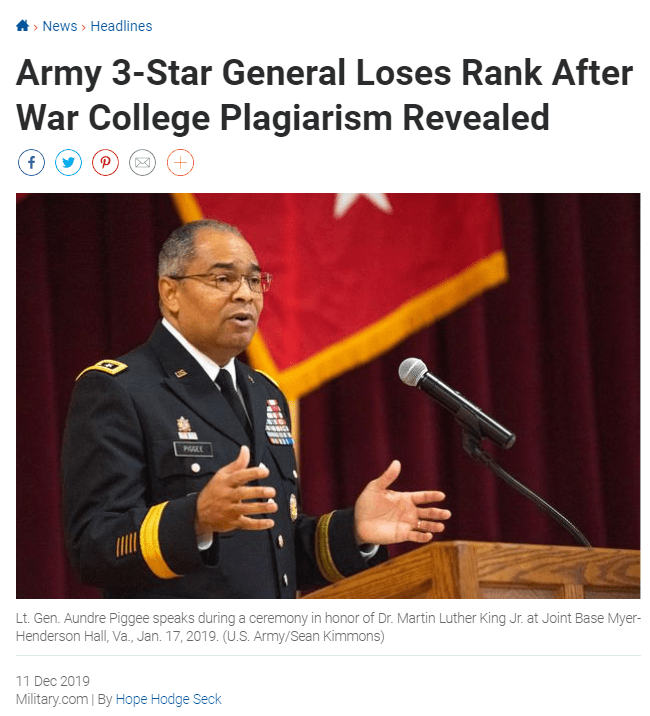
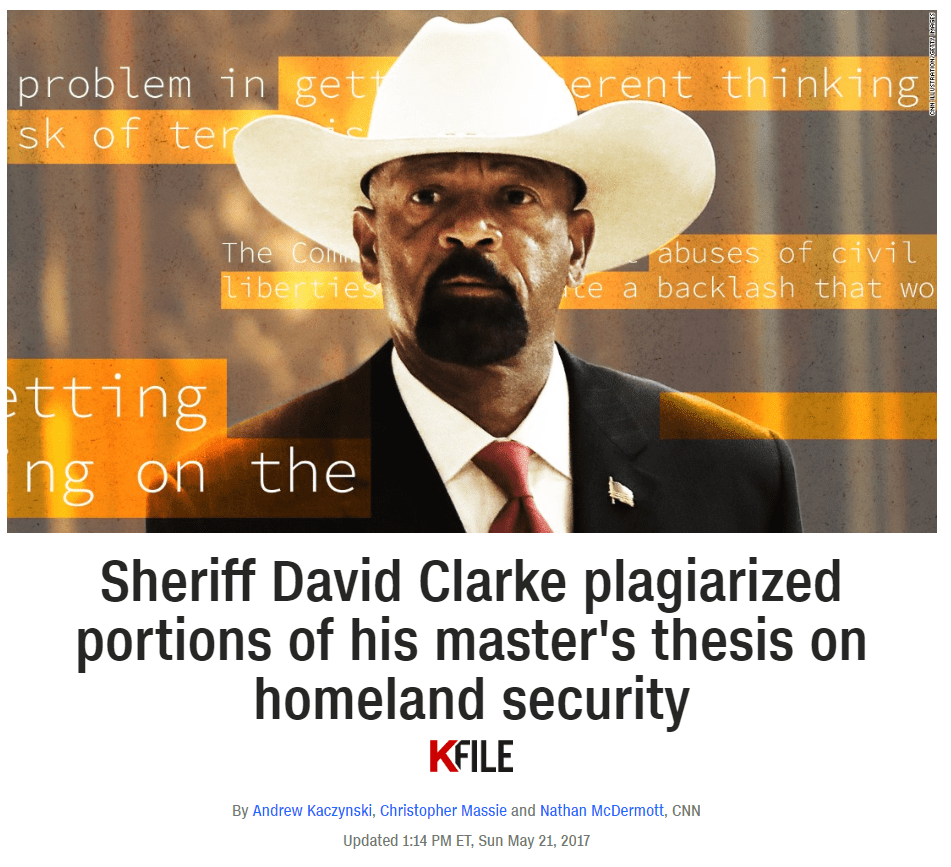
In December 2015, my colleagues and I in the thesis office at the Naval Postgraduate School began running preliminary student thesis drafts through Turnitin (later iThenticate), a plagiarism detection software. I had been working for NPS’s writing center and thesis office for a year and some change, and noticed that students were struggling with attribution. However, they weren’t necessarily aware of the struggle, and of the (predominantly unintentional) concerns that were popping up in their papers. We wanted to ensure that our publicly published theses and dissertations could hold up to scrutinizing academy and media eyes—a concern that proved apt in the following years as public plagiarism cases abounded.

Captured from military.com, 8 Feb. 2020
Captured from CNN, 8 Feb. 2020.

There was one big problem, however, with our noble cause to keep our students’ academic integrity squeaky clean:

subject matter expertise

Analyzing a similarity report from a plagiarism detection software is not as straightforward as it seems (and plagiarism itself is not a straightforward subject, as evidenced from The Hill’s counterargument to CNN’s accusations about Sherriff Clarke, and much debate among academics).

Among the complications of analyzing plagiarism reports are the two shown below, which can go hand-in-hand: false positives and common language.

iThenticate is a plagiarism detection software owned and operated by Turnitin. It is geared more toward academic publishing than traditional class papers.

For information on how the Naval Postgraduate School uses iThenticate, read about the Graduate Writing Center’s approach, and see our iThenticate FAQ.

The writing center coaches who were tasked with analyzing the reports, myself among them, found themselves struggling to distinguish between problematic text matches and common language in our students’ fields.

As coaches, we pride ourselves in our ability to help students with their writing, even if we understand the subject matter superficially. When we got into the weeds of academic writing in this context, however, we had to rely on our students to fill in the knowledge gaps.

This was an important reminder for us at the writing center: though our students are writing in a genre that we know well, their subject matter is an integral ingredient that informs, and indeed helps create, that genre.

Defining Genre

When we think of genres in writing, we tend to think of big categories that define the types of reading we do: fiction and nonfiction; mystery stories and news articles; technical reports and scientific studies; even social media.

And our students are navigating a wealth of genres in their daily life at a military school: government directives and instructions; journal articles and lab reports; command orders and counseling statements; literature reviews and historical analyses.

While genre has been traditionally defined as a system for classifying “types of texts according to their forms,” rhetoric and composition scholar Amy J. Devitt argues that genre is not defined by form alone but rather by form plus content (574). Rather than classifying our reading experiences into distinct categories based on “formal features” (575), she suggests we allow content and social situations to guide meaning-making in our writing.

In this conception, genre allows room for blurred boundaries and evolution. Just as our students must blend their military identities with their academic identities, they must blend their growing military expertise with their new academic expertise. In doing so, they create a blended genre that allows these communities to speak to each other.

Blurred Lines: Genre, Subject Matter, and Meaning-Making

What we often diagnose as ignorance of a situation or inability [for students] to imagine themselves in another situation may in fact be ignorance of a genre or inability to write a genre they have not sufficiently read: they may feel great love but be unable to write a love sonnet.

Devitt (583)

Though Devitt encourages us to resist the rigidity of classification systems, she reminds us, too, not to “discard the significance of form in genre” (575, citing Coe).

Our student writers may be best positioned to communicate with their communities given an understanding of the form of writing for academia, and how their content fits in. After all, both scholarly and military writing are deeply entrenched in the “formal features” of genre that Devitt suggests we work within, but beyond.

Through understanding of and perhaps rebellion against these formal features, our students may best work to blend form and content to fit their audience. And, as Naval Postgraduate School Writing Coach Aby McConnell testifies, a basic formula for understanding the writing assignments they’re tasked with is helpful for our new student writers. Devitt agrees, stating, “If a writer has chosen to write a particular genre, then the writer has chosen a template, a situation and an appropriate reflection of that situation in sets of forms” (582).

As such, based on Devitt’s conception of genre, I offer the below model for our students.

Please see the Works Cited section below for full references.
The Heart of the (Subject) Matter

[E]ach person through genred communication learns more of his or her personal possibilities, develops communicative skills, and learns more of the world he or she is communicating with.

Charles Brazerman (17)

The content of academic writing, as shown in the above model, is where subject matter—and the students’ command over their subject matter—informs and creates scholarly writing as a genre.

As military scholars, our students are writing to an audience of experts and egos—two commonalities between the scholarly and military worlds. Whether graduate students or undergrads, our students come into their writing assignments with growing knowledge and expertise in their military and government fields; and their discourse communities take great pride in this expertise.

But the subject matter they must navigate in school will be new to them. Special Operations Forces officers, for instance, know how to apply unconventional methods in strategic warfare, but have they ever performed a regression analysis to examine the situational variables and arrive at the most statistically sound tactics? Surface warfare officers successfully operate intricate ship systems, but can they come up with code that allows them to train in virtual reality?

Understanding the subject matter, old and new, is even more important in an academic setting because our students are communicating their expertise (old and new) in a new genre, with values that differ from the writing genres of their professional military lives. As described in more detail in my last post, scholarly writing is argumentative and persuasive whereas much of our students’ writing in the military and government is taken for face value. When writing for an academic audience, our students must engage in what Timothy Crusius and Carolyn Channell call “mature reasoning”: they must make arguments that are well informed, self-critical and open to criticism from others, conscious of their audience, and cognizant of context (14).

Academic writing therefore values background information that frames and highlights a problem; it values review of literature, prior research, and evidence to support the importance of the problem and viable solutions. While military and government writing typically prioritizes a single perspective, scholarly writing values discussion of multiple perspectives and counterarguments that strengthen the author’s recommendations and address potential gaps.

By applying their growing knowledge and expertise of military and government subject matter (content) to this new academic writing template (form), however, our students can create meaning. What’s more: they can become more comfortable with their military and academic identities.

Genre and Identity

[U]nderstanding the group’s values, assumptions, and beliefs is enhanced by understanding the set of genres they use, their appropriate situations and formal traits, and what those genres mean to them.

Devitt (582)

Educator and scholar Charles Brazerman believes that “we develop and form identities through participation in systems of genres” (15). College students, he says, participate in these systems of genres as they write papers for their classes, and as they engage with their classmates, professors, and the life of the academy. As they do so, moving from class papers to theses and dissertation, students “reinterpret, hybridize, and improvise upon and within the forms of expression and contribution expected of them” (16, citing Prior).

But while genre feeds identity, identity also feeds genre. By writing in a certain genre, “You develop and become committed to the identity you are carving out within that domain,” Brazerman says (14). So by writing academic papers that address their growing expertise in military subject matter, our students are solidifying their identities as military members and as scholars.

However, they are also pushing the boundaries of their scholarly genres, as Devitt suggests, to respond to the needs of their subject matter. In this sense, “genre is a dynamic response to and construction of recurring situation, one that changes historically and in different social groups, that adapts and grows as the social context changes” (580). Our students’ writing, as I’ve ruminated previously, is an opportunity to harmonize the contact zone between military and academia.

Form and Content at the Writing Center

The question remains, however: How do we get our students there? How can our form + content model equal meaning for our students’ audiences, and how can we facilitate that meaning at the writing center?

Devitt believes that conversations about genre can be useful during the revision process. We can use genre to help our students see, for instance, if their intent matches their execution. As Devitt explains, “In revising, a writer may check the situation and forms of the evolving text against those of the chosen genre: where this is a mismatch, there is dissonance” (582).

Since most writing center work is revision work, genre-related questions for a student might include:

  • What did you set out to prove?
  • Does your thesis statement prove this point, or your eventual conclusion?
  • Have you included this main point upfront, and provided audience-specific context?
  • Where are the specific pieces of proof that you use to support your argument?
  • Are those proofs presented in headings? In topic sentences?
  • Does this paragraph contain evidence to support your claim?
  • How do your sources support—or detract from—your claim?
  • Is your evidence organized clearly and logically?
  • What larger conversation are you joining, and have you addressed that conversation in your introduction and conclusion?
  • Do your recommendations offer actionable solutions?
  • Do your recommendations call back to the context in your introduction?

Here are some tools that may be helpful in examining form as it relates to content and subject matter:

  • Clustering (see Dawson and Essid)
  • Reverse outlining (see UNC Writing Center)
  • Thesis statement refinement (see “Thesis Statements”)
  • “Establishing why your claims matter” (Graff and Birkenstein 303)
  • Mature reasoning checklist (Crusius and Channell 14)
  • “Entertaining objections” (Graff and Birkenstein 82)
  • Writer’s notebook (Crusius and Channell 17–19)

Works Cited

Bazerman, Charles. “Genre and Identity: Citizenship in the Age of the Internet and the Age of Global Capitalism.” The Rhetoric and Ideology of Genre: Strategies for Stability and Change, edited by Richard Coe et al., Hampton P, 2002, pp. 13–37.

Crusius, Timothy W., and Carolyn E. Channell. The Aims of Argument: A Brief Guide. 5th ed., McGraw-Hill, 2005.

Dawson, Melanie, and Joe Essid. “Prewriting: Clustering.” University of Richmond Writing Center, 2018, writing2.richmond.edu/writing/wweb/cluster.html.

Devitt, Amy J. “Generalizaing about Genre: New Conceptions of an Old Concept.” College Composition and Communication, vol. 44, no. 4, Dec. 1993, pp. 573–86.

Graff, Gerald, and Cathy Birkenstein. They Say / I Say: The Moves That Matter in Academic Writing. 3rd ed., W.W. Norton, 2017.

“Thesis Statements.” University of North Carolina at Chapel Hill Writing Center, writingcenter.unc.edu/tips-and-tools/thesis-statements/. Accessed 12 Feb. 2020.

UNC Writing Center. “Reverse Outlining.” YouTube, 6 Sept. 2018, www.youtube.com/watch?v=SZxphibAqb4&feature=youtu.be.

Sources Consulted: Academic Writing Formula Infographic

“Academic Writing.” Purdue Online Writing Lab, owl.purdue.edu/owl/general_writing/academic_writing/. Accessed 8 Feb. 2020.

“Argument.” University of North Carolina at Chapel Hill Writing Center, writingcenter.unc.edu/tips-and-tools/argument/. Accessed 8 Feb. 2020.

Crusius, Timothy W., and Carolyn E. Channell. The Aims of Argument: A Brief Guide. 5th ed., McGraw-Hill, 2005.

Devitt, Amy J. “Generalizaing about Genre: New Conceptions of an Old Concept.” College Composition and Communication, vol. 44, no. 4, Dec. 1993, pp. 573–86.

“Joining the Academic Conversation.” Naval Postgraduate School Graduate Writing Center, my.nps.edu/web/gwc/joining-the-academic-conversation. Accessed 8 Feb. 2020.

“What We Do.” The Green Belt Movement, www.greenbeltmovement.org/what-we-do. Accessed 8 Feb. 2020.

Maathai, Wangari. “An African Future: Beyond the Culture of Dependency.” Open Democracy, 27 Sept. 2011, www.opendemocracy.net/en/an-african-future-beyond-the-culture-of-dependency/.


The views expressed on this website are the author’s alone. They do not reflect the views of the Naval Postgraduate School.
Clash of Clans: Military vs. Academia

By Aileen Brenner Houston

How can the writing center help military students communicate successfully with their polarizing audiences: military and academia?

Exploring how writing can bridge the gap between military students’ discourse communities.

The struggle of the student writer is not the struggle to bring out that which is within; it is the struggle to carry out those ritual activities that grant our entrance into a closed society.

— David Bartholomae

It’s 07:55 on a Tuesday. Uniform day. Your black leather shoulder bag—carried by hand today, no danger of the strap displacing your carefully positioned medals and ribbons—still smells of cinnamon and blueberries, remnants of your daughter’s oatmeal flecked unceremoniously in the bag’s lining. You’d scooped out most of the gloopy mess with a paper towel on your drive to campus (you had planned to bike, to keep up with PT, but you were running late after the breakfast incident), but you can see the first printed-out page of your literature review peeking from between your books, and it’s earmarked with drying milk and oats.

You whisk into the library through the Starbucks entrance. It’s 07:56. Your writing center appointment is at 08:00. You’d been lucky to snag the first appointment of the day—enough time to regroup before your 10:00 class—but now you have a choice to make: print a fresh copy of your paper to avoid sticky cinnamon stains on your dress uniform sleeve, or risk a dry-cleaning run in favor espresso, the sumptuous Starbucks aroma tempting you to the counter.

You are a student at the Naval Postgraduate School trying to mesh your military life with your academic life, and you will need an alarming amount of coffee to get through this day.

Military and Academia at the Graduate Writing Center

Five and a half years ago, I showed up, at 07:55 on a Tuesday, for my first day as a full-time writing coach at the Naval Postgraduate School’s Graduate Writing Center. Unlike many collegiate writing centers, which are staffed by part-time student tutors, the writing center at NPS has a full-time staff of professional academic coaches and instructors. It was my dream job, though it came with a degree of unease. As a relatively new military spouse but a long-time writing tutor and editor, I was more comfortable among the library’s musty book stacks and old-coffee-bean aroma than I was in the sea of ironclad military officers with carefully combed high-and-tights.

It didn’t take long, however, for me to discover that the students were much more uncomfortable with writing than I was with being called ma’am.

My students and I were on polar ends of a contact zone—language expert Mary Louise Pratt’s term, introduced in my previous post, for a place where cultures meet and clash, particularly when it comes to language and writing norms.

No, not the 1990s Jodie Foster kind of Contact zone (though writing in outer space might be relevant for our new Space Force officers). Image from the Daily Mail

Back when I started, the writing center at NPS was still new: a fledgling response to the Navy Inspector General’s call for improved research and writing at its graduate educational institution. Though NPS was established in 1909, it wasn’t until 2012 that the Navy Inspector General commented on how the disconnect between its two discourse communities, military and academia, was manifesting unfavorably in student writing.

The Graduate Writing Center came to be shortly thereafter, and has grown into a mighty force. On my first day at the writing center, I was one of only six writing coaches; today there are fourteen coaches who offer one-to-one sessions along with a robust schedule of teaching, presentations, and resource creation.

What hasn’t changed in that time, however, is the culture clash between military and academia, and our job at the writing center to negotiate those two worlds so that our students can effectively communicate with, and perhaps harmonize, these polarizing discourse communities.

Brass versus (8 a.m.) Class

Discourses, for me, crucially involve … characteristic ways of acting-interacting-feeling-emoting-valuing-gesturing-posturing-dressing-thinking-believing-knowing-speaking-listening (and, in some Discourses, reading-and-writing, as well).

—James Gee (38)

While military students are writing for familiar faces in the national security world, they’re writing for new ones as well: academics. It is government officials and policymakers—some of whom are academics, some military—who come together to review our military’s national security options, including the student writing that departs military institutions such as the Naval Postgraduate School.

James E. Porter, a prolific author of books on professional communication and rhetoric, defines a discourse community as “a group of individuals bound by a common interest who communicate through approved channels…. Each forum has a distinct history and rules governing appropriateness to which members are obliged to adhere” (228). At military schools, the academic and military discourse communities collide, creating a contact zone of official channels, recognized rules, customs, and communication norms. The students must simultaneously negotiate both sets of norms: they must strive for continued success in their ongoing military careers, which now depend on their academic success.

The difficulty comes in when the norms of these communities, at their core, clash. Howard Wiarda, a former professor at the Naval War College, explains that while the military prioritizes unquestioned order and discipline, academia leans toward skepticism and irreverence (107). And the different “social identities,” as James Gee calls them, that are created around such different disciplines “may seriously conflict with one another” (16). Where the military is bureaucratized and hierarchical—its structure defined legally and its members’ commitment defended to the death (Jordan and Taylor 130)—academic thought requires students to challenge hierarchical notions and forge their own path.

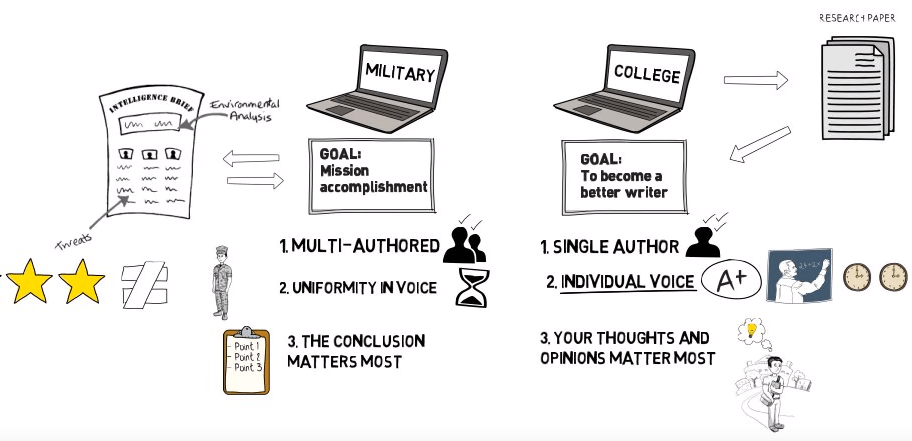
The clash of clans between the academic and military discourse communities includes a clash in writing norms and conventions. Below, for example, is one educator’s take on the major differences between writing for the military and writing for college (in the comments for this blog post below, I invite you to weigh in on these assertions).

Writing for the military vs. writing for college. Image from Uvize

At a military college, however, we must respect the approaches of both discourse communities. Gee believes that students are capable of filling simultaneous roles in disparate discourse communities, but admits that “they may face very real conflicts in terms of values and identity” (17). Our job at the writing center is to ease the conflict—to help students translate their military and government experience into academic logic so that they might communicate in and among their discourse communities. It helps, as mentioned in my previous post, to create narratives with them that embrace their new academic identities, build confidence, and connect their worlds.

Harmonizing the Contact Zone
Not So Different?

Despite their fundamental differences, the military and academia have much in common, particularly, if counterintuitively, when it comes to writing conventions.

In 1973, Amos Jordan, a retired brigadier general and professor at the United States Military Academy, and Lieutenant Colonel William Taylor, Jr., also a professor at the Military Academy, recognized a need to reform the military officer education system. In doing so, they highlighted where the military and the academy collide: “The military has many of the same characteristics as the other professions; namely, a specialized body of knowledge acquired through advanced training and experience, a mutually defined and sustained set of standards, and a sense of group identity and corporateness” (130, citing Janowitz).

With these foundational similarities in mind, Desirae Giesman, an editor for Military Review, points to some hallmarks and underappreciated purposes of effective writing for military leaders. Perhaps surprisingly, many are hallmarks of effective academic writing as well:

  • active voice
  • clarity
  • error-free, standard English sentences
  • a style that “account[s] for the effective thinking and reasoning that must underlie effective explanations”
  • a goal to “help writers become skilled thinkers and communicators … to enhance their critical and creative thinking” (107)

When it comes to writing, the military and academic communities also have just that in common: community. Writing is often seen as a solitary task. How often do you walk through silent study halls and libraries to find tortured seniors holed away in a lonely carrel, invisible yet menacing do-not-disturb signs strung across their laptops as they type?

Image from Coin Phrases

As described by Porter, however, the concept of intertextuality—the idea that all texts relate to and rely on other texts—reminds us that writing is not an individual act; it is a social one. This is true, regardless of preconceived notions, both in the military and the academy.

When we ask students to write, we are not asking them to invent the wheel; we’re asking them to join conversations about an existing wheel—to be part of larger efforts to make the wheel more effective, or to build solutions based on its design and uses. This is the idea behind intertextuality, but it is also the foundation of academic thought…and of military thought.

Academic papers typically review the literature that has come before them to show the historical importance of and debate surrounding the concepts. National and global security, too, are not new concepts; they predate the academy, even. Our students’ job is to use intertextuality—to study and join the conversations, past and present, of academics and of government partners—to understand where we have been, where we are, and what we should do to get to where we want to be.

Publish or Perish
Image from Cartoon Stock

The saying “publish or perish” is a famous warning among academics, pointing to the importance of continued research and writing for the professoriate. At many institutions, faculty are expected, or required, to publish research as a condition of tenure. Associate Professor Christopher Schaberg, writing for The Chronicle of Higher Education, argues that publishing fuels teaching for professors, and offers an important way for them to communicate.

Publishing is a priority for the U.S. government, too. In its most recent strategic plan, the Government Publishing Office makes it a specific goal to “[increase] the amount of U.S. Government information available for free to the public” (6). This goes back, according to the GPO, to the government’s constitutional obligation to keep citizens informed of its proceedings—specifically through publishing (3). Indeed, in his Guide to Effective Military Writing, William McIntosh calls to this obligation, claiming that “The armed services, like other branches of government, appear almost obsessed with writing” (3).

This shared emphasis on writing and publishing can teach military and academia “how to speak to each other” (Ruszkiewicz 9).

In the publication process particularly, these seemingly at-odds discourse communities collide: the research and writing process involves the skepticism and logic of academia, while the citations, formatting, and editing in the publication process emphasize the order and discipline of the military. During the thesis publishing process at NPS, for instance, we take special care to explain the “logic and good sense” (Wiarda 107) behind citation and grammar norms, working to help each document speak to an academic audience that applauds perfection. As military officers, our students are not strangers to the pursuit of perfection, nor to the pursuit of being heard through a crowd.

Publishing goes beyond giving our students membership into the academic discourse community. It also calls to the social foundations of both the military and academic communities, and merges them to form a unique community of its own.

A New Discourse

Discourses have no discrete boundaries because people are always, in history, creating new Discourses, changing old ones, and contesting and pushing the boundaries of Discourses.

—Gee (21)

Through language and writing, we engage in our social identities and our communities’ conversations; through language and writing, however, we also create our social identities and our communities’ conversations. This is the magic of language, according to Gee (11).

By recognizing the overlapping conventions in military and academia, and by understanding the social languages of these discourse communities, our students have a unique opportunity to join a new, blended discourse community. One that uses academic thought to enhance national security, and that uses their military prowess to advance research.

We must remember not to treat military students as empty vessels that need to be filled and molded. Instead, we must treat them as what they are: minds filled with valuable knowledge and experience, which we can help them expand and translate into academic thought for the shared benefit of their discourse communities.

At the writing center, particularly, we must also remember that our students are service members and public servants. They are budding academics, yes, but they are also cultivating demanding careers for which work-life balance is a known struggle. A service member’s social identity is deeply informed by home and family life, as it is by . We must leave space for our students’ “new Discourses” to be informed by study and service, but also by the sticky cinnamon stains from their daughter’s drying oatmeal.


Works Cited

Bartholomae, David. “Writing Assignments: Where Writing Begins.” Forum: Essays on Theory and Practicing in the Teaching of Writing, edited by Patricia L. Stock, Boynton/Cook, 1983.

Gee, James. Introduction to Discourse Analysis: Theory and Method. Routledge, 1999.

Giesman, Desirae. “Effective Writing for Army Leaders: The Army Writing Standard Redefined.” Military Review, Sept.-Oct. 2015, pp. 106–18, www.armyupress.army.mil/Portals/7/military-review/Archives/English/MilitaryReview_20151031_art016.pdf.

GPO FY18-22 Strategic Plan. U.S. Government Publishing Office, www.gpo.gov/docs/default-source/mission-vision-and-goals-pdfs/gpo-strategic-plan-fy2019-2017.pdf. Accessed 23 Jan. 2020.

Jordan, Amos A., and William J. Taylor Jr. “The Military Man in Academia.” The Annals of the American Academy of Political Science, vol. 406, Mar. 1973, pp. 129–45.

McIntosh, William A. Guide to effective Military Writing. 3rd ed., Stackpole Books, 2003.

Porter, James E. “Intertextuality and the Discourse Community.” Rhetoric Review, vol. 5, no. 1, 1986, pp. 34–47.

Pratt, Mary Louise. “Arts of the Contact Zone.” Profession, 1991, pp. 33–40.

Ruszkiewicz, John J. “Writing ‘in’ and ‘across’ the Disciplines: The Historical Background.” Annual Meeting of the National Council of Teachers of English, 19–24 Nov. 1982, Washington, DC, files.eric.ed.gov/fulltext/ED224024.pdf.

Schaberg, Christopher. “Publish or Perish? Yes. Embrace It.” The Chronicle of Higher Education, 15 Feb. 2016, www.chronicle.com/article/Publish-or-Perish-Yes/235319.

Wiarda, Howard J. Military Brass vs. Civilian Academics at the National War College: A Clash of Cultures. Lexington Books, 2011, ebookcentral-proquest-com.libproxy.nau.edu/lib/nau-ebooks/detail.action?docID=716051.


The views expressed on this website are the author’s alone. They do not reflect the views of the Naval Postgraduate School.
Design a site like this with WordPress.com
Get started