By Aileen Brenner Houston
How can writing centers harness public communications concepts to engage with students and faculty?
Exploring social media use for military writing centers.
[T]he best breaker of old rhythms, the best creator of new ones, is our style of live intervention, our talk in all its forms.
Stephen North
If writing centers are going to offer advice on communicating effectively, they ought to be able to prove they know how to do it out in the wild, right?
Nancy Vazquez
SCENE: Monday. 0900. Finals week. The writing center. Your first appointment of the day. You snagged the work station by the window. Plants are watered. Birds are chirping. Pens are organized by color and bleed risk. Your tea is warm, and your copy of The Bedford Guide for Writing Tutors is peeking from the bookshelf. You’re having an unusually good morning.
ENTER: Frantic senior. Has never used the writing center. Hasn’t had coffee yet. This is apparent.
YOU: Finals week, am I right?
SENIOR: [Stares at you blankly. Sets phone on table. Facebook app dings.]
YOU: Amiright, haha?? [Big smile]
SENIOR: [Plots your death]
Silence. Birds stop chirping. Plants wilt noticeably.
YOU: I read through your paper, thanks for sending it in advance. You have a strong thesis statement. Your client form didn’t say what you’d like to work on, but we could discuss methods for more clearly linking your evidence to the thesis statement, to help its strength ride through the literature review and conclu—
SENIOR: My professor said I can’t turn this in until I fix the grammar mistakes. He told me to go to the writing center.
Your tea mug falls over spontaneously, violently.
YOU: Oh, OK. I did mark a few patterns I noticed, like some issues with parallel construction in the literature review, so we could certainly kill two birds. Have you heard the term parallelism before when talking about grammar?
SENIOR: Really I just need the paper to be corrected. Like, proofread.
Somewhere in New York, Stephen North tweets about a sudden migraine.
YOU: Well, we don’t really proofread at the writing center, but we can definitely look at some patterns and revision techniques.
STUDENT: That’s what my professor sent me here for, though. He said to have it proofread. Can’t you just fix it?
Cold oolong bleeds onto your lap. Your Bedford Guide jumps from the shelf, stabs itself in heart.
—END SCENE—
Social Misconceptions
In his infamous “The Idea of a Writing Center,” published in 1984, English professor and writing center director Stephen North is exasperated. On college campuses, he laments, writing centers are misunderstood, seen as a place for remedial instruction and quick grammar fix-its. He delves into the misplaced stigmas about writing centers and his frustrations with the academy attitudes that perpetuate them.
“In short,” North says, “we are not here to serve, supplement, back up, complement, reinforce…. We are here to talk about writers.” This includes, he says, talking to faculty about the work of writing centers in our quest to dispel myths and craft more accomplished student communicators (440–41).
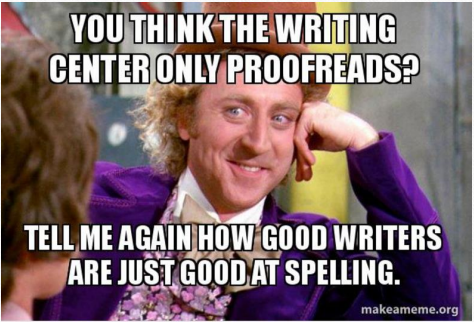
To do that, however—to talk to writers, to talk to faculty—we also need them to talk to us. With us. This means relying on talk, to borrow from North, “in all its forms” (443). Which in turn means seeking, and fostering, authentic conversations with students and faculty.
Campus engagement is a necessity for all writing centers, including those at military colleges—and especially for writing centers like ours at the Naval Postgraduate School, where there is no course-mandated requirement for students to take advantage of our resources.
As our students slide into younger generations for whom public, web-dependent communications are the comfortable norm (see Twenge), and as military and civilian programs alike increase their focus on online and distance-learning platforms (Education for Seapower; Vazquez), social media offer an avenue for engagement worth exploring.
Social Media in the Military and the Writing Center
By 2021, estimates project that 3.1 billion people worldwide will be using social media; this is an impressive 17% increase from 2018, and a 12% increase from 2019 (Clement; Dopson). The are a wide breadth of platforms, some of the most popular of which are shown below.
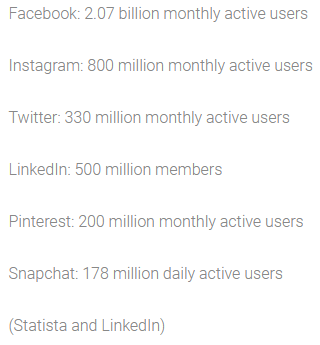
Our students are among these social media users (see Boykin and Rice). And so are their commanders, their generals, their secretaries of defense, and their joint chiefs of staff, who use social media to communicate both personally and professionally (Walinski 10).
The U.S. military, as an organization, also understands the importance of harnessing social media toward engagement. In his Air University master’s thesis, Major Ryan Walinski notes, “As technology continues to develop, and online communication becomes more prevalent worldwide, the U.S. military believes that the foundation of their future relevant communication interaction will occur by leveraging New Media technologies and infusing the technology into their military culture” (1).
Walinski explains that social media has been used in the military (for over a decade now) to disseminate information, educate the public, gather “dynamic feedback,” improve the military’s image, boost troop morale, and dispel rumors (14–17).
Social media is a growing necessity in the nonprofit world, as well, where various platforms are used to share news, foster brand recognition, and fundraise—all with an eye for audience convenience (Dopson).
For writing centers, social media offer platforms to combat the myths and stigmas over which North laments. Nancy Grimm, once director of the writing center at Michigan Technological University, believes this type of attention and engagement is in our nature as writing center professionals. “Because writing centers have been in vulnerable positions for many years,” she writes, “they are accustomed to frequently checking to see how they are regarded by others and adjusting their behavior and adapting their services to improve this regard” (534). Because social media can be leveraged to proactively engage faculty, students, and administration, the platforms may allow us to spark and foster dialogue, and address conflict (see Ullmann 4–6).
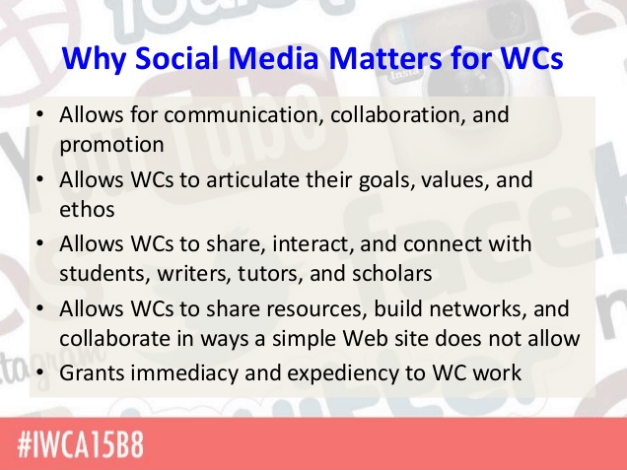
Advocates for social media use at writing centers tout the platforms’ ability to promote campus awareness about the center, facilitate networking opportunities with other writing centers, and provide cheap, effective marketing (“Boosting Your Writing Center’s Social Media Presence”). Though it can be a time-consuming undertaking admits Jennifer Fandel, administrator of the University of Wisconsin–Madison Writing Center, “Communicating online, where people can take action by clicking a link or forwarding a message, is crucial for the opportunity it gives an organization to see that people are listening.”
Everything’s Bigger in (the) Texas (A&M Writing Center)
While some military writing centers have dabbled in social media use, the most prolific current examples come from civilian institutions. Texas A&M’s University Writing Center offers a robust example. For instance, the center advertises events and services on its Facebook page, where it also shares articles and memes.
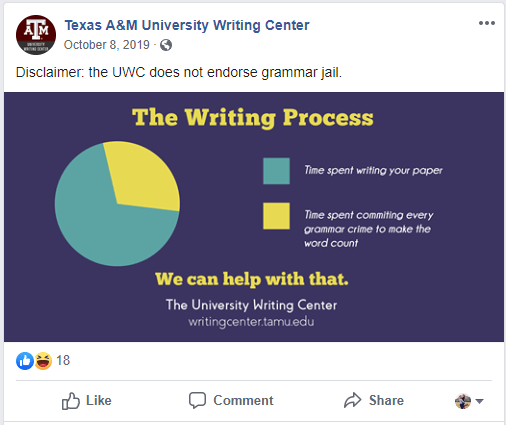
But Texas A&M doesn’t stop there: the writing center maintains active and responsive accounts, too, on Twitter, Instagram, Pinterest, and YouTube. Some of its YouTube videos have over 100,000 views.
As a testament to its social media engagement, I reached out to the Texas A&M University Writing Center through Facebook Messenger, and the center’s director, Nancy Vazquez, responded in a staggering thirteen minutes.
The writing center’s social media strategy, Vazquez explains, is about balancing content. “While we’re certainly using platforms to push our message,” she says, “we also offer content that’s just meant to be engaging and enjoyable. Nobody goes on social media to read a press release. We try to balance announcements about our services and events with general social media shenanigans.”
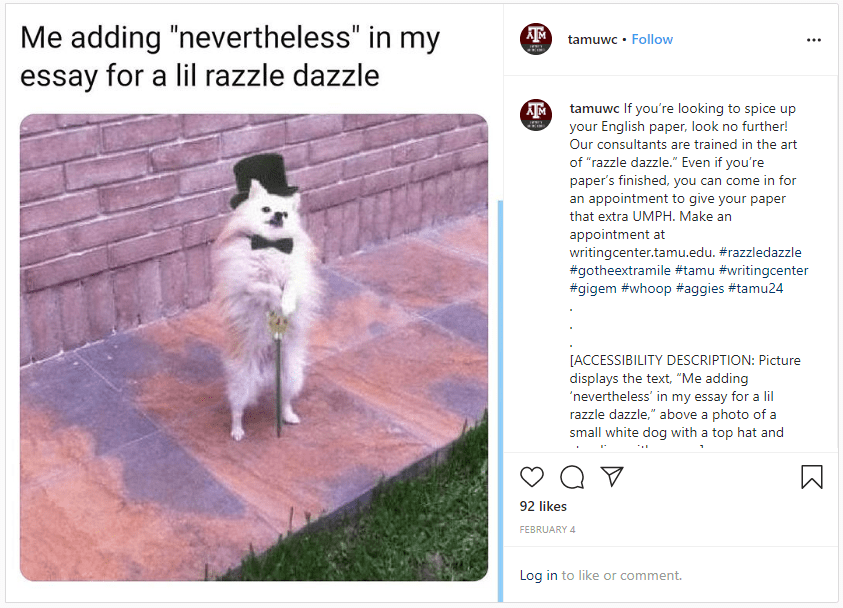
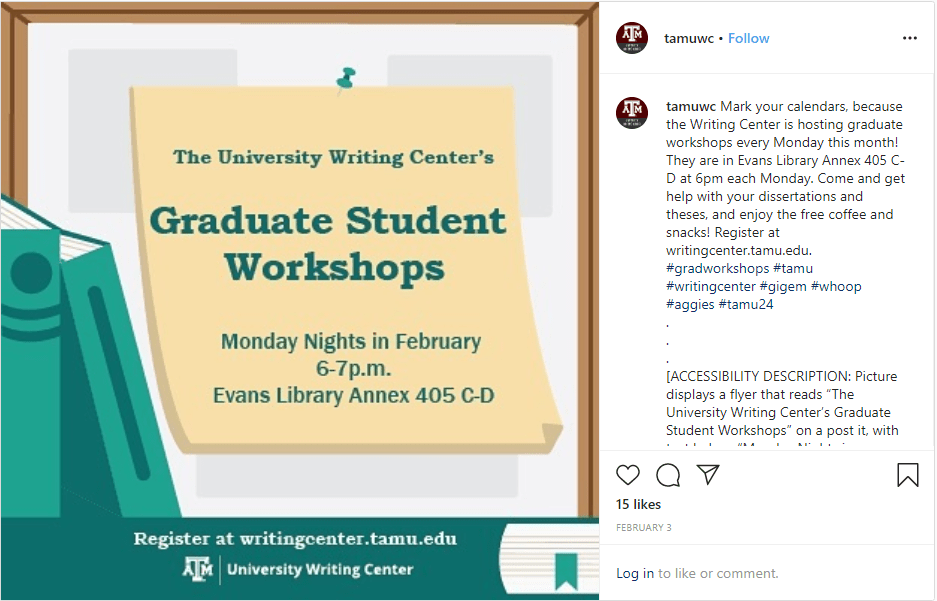
This approach is in action on the center’s Instagram account, where Vazquez says the writing center tends to catch current students. Most of the center’s Instagram content is posted by student representatives, under the administrators’ guidance.
But the center’s social media use goes beyond student engagement. Vazquez says the sites allow them to model “good communication practices” that show students how to adjust their content and tone for different rhetorical situations. The social media sites have also boosted the writing center’s “profile” within the university community, which Vazquez believes is “just as important as reaching individual students.”
Stars and Stripes and Social Media
Although social media platforms provide military leaders, organizations, and individuals a tool for open communication … they bring with them a variety of new concerns, risks, and challenges.
Walinski (20)
As Walinski notes in his thesis, public communication and social media strategies are particularly complicated for government organizations. We must carefully avoid posting PII or FOUO content, and must be vigilant of OPSEC (22). Walinski concludes, however, that the Department of Defense “must not resist the use of this technology altogether but learn to incorporate its use, while maintaining security protocols, into their daily environments” (24).
Our service academies typically already have robust social media policies to guide us. At NPS, for instance, common-sense guidance such as “stay on topic” and “consider your audience” serves a larger purpose of preventing inadvertent OPSEC violations (“Social Media Guidelines”). Policies also require web content to comply with Section 6 (“Polices and Requirements”), and link to relevant directives and instructions (see, for instance, Secretary of the Navy 7-21–7-22).
Luckily, as most military writing centers maintain pages or blogs on their college or university’s larger website, administrators are likely familiar with web guidelines; if they are not, the Public Affairs Office is a good place to start.
The service branch may also have social media guidance, such as the Navy Command Leadership Social Media Handbook, which explains how command teams should set objectives, select platforms, and abide by records-keeping policy. While designed for command teams, such guidance can help military writing centers understand their audience and communicate within genre expectations in the discourse community.
Forward March: Social Media Considerations for Writing Centers
[The Army] wanted to open up lines of communication that reached across all generations and demographics, with the goal of initiating conversation and dialogue-centric interchanges.
Walinski (14, citing Perry)
Before establishing social media sites, marketing writer Elise Dopson reminds organizations to plan ahead by:
- Deciding what they want to achieve with their social media presence
- Setting goals
- Understanding their target audience
- Determining which platforms are most useful
- Developing a strategy
- Considering time management
Walinski describes cultural considerations, too, that may affect social media use among and between the different military branches (29–34).
The University Center for Writing-based Learning at DePaul University goes over some basics, such as how to create appropriate and professional Facebook and Twitter accounts that lend to searchability (“Boosting Your Writing Center’s Social Media Presence”). They also offer some tips for initial post content:

Fandel gives good advice about the necessity of multimodality in social media posts—but for the sake of engagement rather than multimodality itself. “While an image to help people conceptualize a workshop” is helpful, she says, “photos of real-life people still seem to garner the most views…. When it comes down to it, for those unfamiliar with the work of Writing Centers, it’s helpful to see a smiling face and know that that’s the person you might meet.”
For Vazquez at Texas A&M, a solid writing center social media strategy reevaluates the best uses for each platform as it evolves, focuses on staying relevant, and creates the right impression of the center as a service provider. “As part of that,” Vazquez says, “we decided early on not to joke about language errors; that’s part of dispelling the myth that we’re all about ‘correctness.’”
Works Cited
“Boosting Your Writing Center’s Social Media Presence.” University Center for Writing-Based Learning / DePaul University, 6 Mar. 2013, ucwbling.chicagolandwritingcenters.org/writing-centers-social-media/.
Boykin, Gary L., Sr., and Valerie J. Rice. “Exploring the Use of Technology among U.S. Military Service Members and Veterans.” Proceedings of the Human Factors and Ergonomics Society 59th Annual Meeting, 2015, pp. 869–73.
Clement, J. “Number of Global Social Media Users 2010–2021.” Statista, 14 Aug. 2019, www.statista.com/statistics/278414/number-of-worldwide-social-network-users/.
Dopson, Elise. “Social Media for Nonprofits: How to Make an Impact with Little Budget.” Sendible, 6 Sept. 2018, www.sendible.com/insights/social-media-for-nonprofits.
Education for Seapower. Department of the Navy, Dec. 2018, www.navy.mil/strategic/E4SFinalReport.pdf.
Erwin, Ben, et al. “Meme & Monument: Writing Center (R)evolution through Effective Social Media Strategies.” IWCA 2015 Conference, 9 Oct. 2015, Wyndham Grand, Pittsburgh, PA, www.slideshare.net/julieplatt/meme-monument-writing-center-revolution-through-effective-social-media-strategies. Workshop.
Fandel, Jennifer. “Conversation Starter: Social Media and the Writing Center.” Another Word / University of Wisconsin-Madison Writing Center, 12 Dec. 2018, dept.writing.wisc.edu/blog/conversation-starter-social-media-and-the-writing-center/.
Grimm, Nancy Maloney. “Rearticulating the Work of the Writing Center.” College Composition and Communication, vol. 47, no. 4, Dec. 1996, pp. 523–48.
Ibrisevic, Ilma. “7 Nonprofit Social Media Trends Taking Over 2019.” Donorbox Nonprofit Blog, 13 July 2018, donorbox.org/nonprofit-blog/7-nonprofit-social-media-trends-taking-over-2018/.
Navy Command Leadership Social Media Handbook. Department of the Navy, Fall 2012, my.nps.edu/documents/10180/112154075/Navy+Social+Media+Handbook+Fall+2012.pdf/d073a7ce-35c5-45be-8842-41875b1f01e2.
North, Stephen M. “The Idea of the Writing Center.” College English, vol. 46, no. 5, Sept. 1984, pp. 433–46.
“Policies and Requirements.” Naval Postgraduate School, my.nps.edu/requirements-for-websites. Accessed 26 Feb. 2020.
Secretary of the Navy. Department of the Navy Public Affairs Policy and Regulations. SECNAVINST 5720.44C. Department of the Navy, 21 Feb. 2012, www.navy.mil/ah_online/OPSEC/docs/Policy/SECNAVINST-5720_44C_PAO.pdf.
“Social Media Guidelines.” Naval Postgraduate School, my.nps.edu/social-media. Accessed 26 Feb. 2020.
Twenge, Jean M. iGen: Why Today’s Super-Connected Kids Are Growing Up Less Rebellious, More Tolerant, less Happy—And Completely Unprepared for Adulthood. Ataria Books, 2017.
Ullman, Noah John David. Socio-technical Barriers and Benefits of Leveraging Social Media within the Writing Center and the Classroom at Michigan State University: Understanding the Conflicts Caused by Different Modes of Production on Group Behaviors. 2010. Michigan State U, MA thesis.
Vazquez, Nancy. Personal interview. 26 Feb. 2020.
Walinski, Ryan G. The U.S. Military and Social Media. 2015. Master’s thesis, Air University, apps.dtic.mil/dtic/tr/fulltext/u2/a626009.pdf.
The views expressed on this website are the author’s alone. They do not reflect the views of the Naval Postgraduate School.
 writingforseapower.water.blog
Hi, Alieen,
You did such a wonderful job on your website. It looks beautiful, and you incorporate graphics and other engaging material so well. Your topic is also very interesting. I had not considered military academies and their separate challenges, and the parallel discussion on writing centers. I do feel like writing centers should also work on grammar, because, in my opinion, it is the foundation of clear writing, but that is an argument for another day.
I loved how you got an interview from a writing center director at Texas A&M, that is amazing. I reached out to writing center people and university board members last semester for a paper, and I never heard anything. I’m very impressed. I think it would have been nice to hear more about military writing centers and their specific challenges.
I also liked your discussion about social media and how it can be used effectively for college writing centers, I didn’t think about that. It made me wonder how English Departments could also use social media to talk about different challenges and engage with the writing center.
There were a few acronyms I did not know. I think it would have been nice to have their real names written out. I looked back through the blog, but I couldn’t find any other references. Of course, it is possible that they are mentioned in other posts that I have not read.
There was one little word typo thing in the quote by Vazquez at the beginning of the article. It says, “out” instead of “ought.”
Great job. It was a fun, easy read.
Jazzy
LikeLike
Hi Aileen,
What an outstanding blog! Your content is so engaging and well presented. Your areas of expertise (WCs/ the military) are both outside of my personal experience, but you do a great job of framing your discussion in a way that is relatable to a broad audience. I think that your intro “scene” was an especially clever way to get your readers engaged, and to have them build empathy with some of the struggles that you go on to discuss. I also appreciate your emphasis on the way that social media can be used with a balance of silly and serious content. As you mention, nobody goes on social media looking for pure information. Your own blog achieves a similar effect by alternating between sections that are humorous and sections that are relatively serious or informative. Again, excellent work, and I wish you the best as you keep working in this space!
LikeLike